BUILD CARD · EASY
Slide Switch Color LED
Use a slide switch to control a protected color-changing LED.
- Time
- 10 min
- Age
- 8+
- Pieces
- 6
- Board
- 10×7
- Build and check a 10×7 snap-grid circuit from a visual diagram.
- A latching switch keeps the protected color LED powered until the switch is opened.
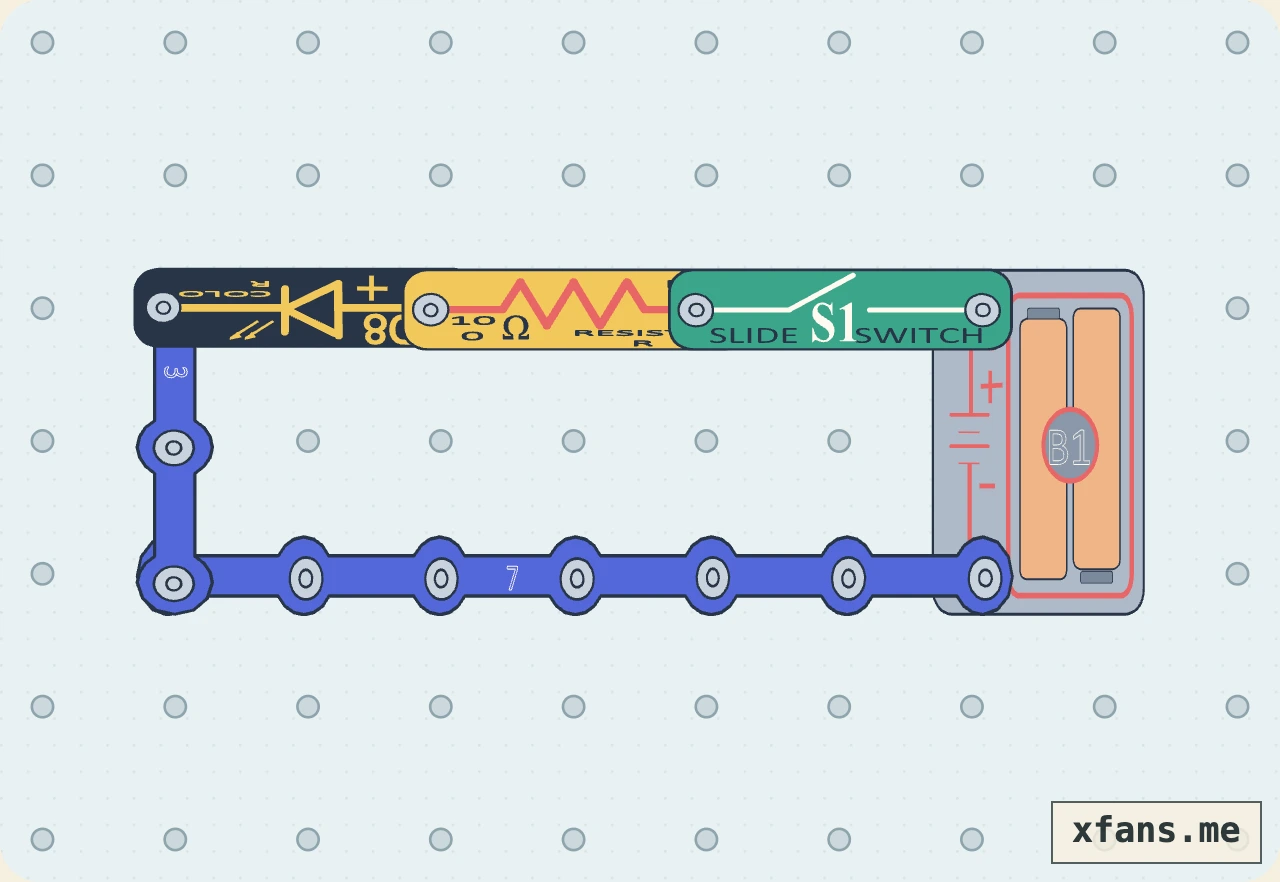
02 / PARTS CHECK
Parts list
- 1×7-snap wireconnector
- 1×3-snap wireconnector
- 1×Color LEDsemiconductor
- 1×100 Ω resistorresistor
- 1×Slide switchswitch
- 1×3V two-cell battery holderpower
03 / ASSEMBLY
How to build the circuit
- 1
Disconnect the battery and clear the base grid before placing any part.
- 2
Match the final diagram one grid position at a time, placing connecting wires and lower layers first.
- 3
Check the direction of every LED, diode, transistor, battery, and other terminal-sensitive part.
- 4
Press every shared snap firmly, check that no wire shorts the battery, then connect power last.
04 / FIELD NOTES
How it works
Closing the slide switch completes the circuit.
The resistor protects the color LED from excessive current.
Opening the switch stops current and turns the LED off.
Explore more led circuit projects →
05 / TEST
Test and expected result
- What to do
- Close the slide switch, observe the color sequence, then open it.
- What to expect
- The color LED remains powered in the closed position and stops when the path opens.
06 / SAFETY
Build smart
- Use only the recommended battery pack and voltage.
- Disconnect the battery before moving or replacing parts.
- Stop immediately if a part becomes hot, smells unusual, or behaves unexpectedly.
07 / TROUBLESHOOTING
If it does not work
- Compare every part position and connection with the circuit diagram.
- Check that every snap connection is firm and the batteries still have power.
- Confirm polarized parts such as LEDs, diodes, and transistors face the correct direction.
08 / FREQUENTLY ASKED QUESTIONS
Questions about this circuit
What is the main idea behind this circuit?
A latching switch keeps the protected color LED powered until the switch is opened.
What should I check first if it does not work?
Compare every part position and connection with the circuit diagram.
09 / RELATED BUILDS
Try a similar circuit
Continue with another build that shares the same components, ideas, or difficulty.
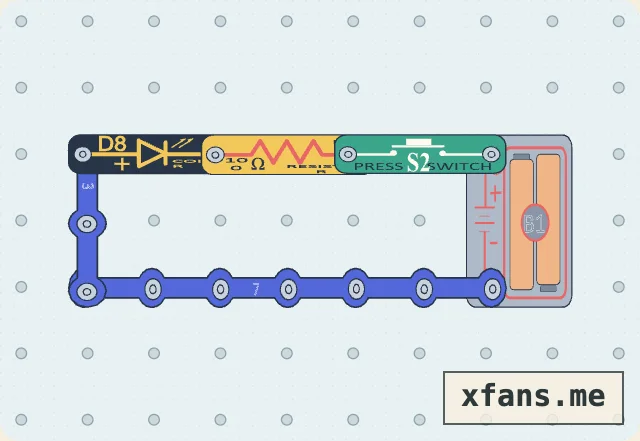
Pushbutton Color Light
A momentary-switch version of manual Project 2 with a protected color LED.
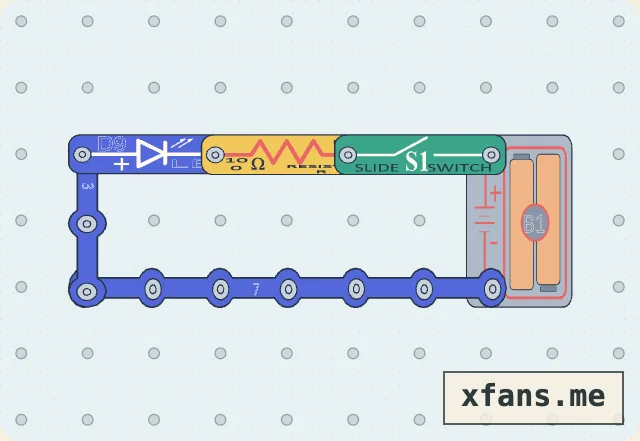
Blue LED Switch Light
Replace the color LED in manual Project 2 with a blue LED and keep the current-limiting resistor.
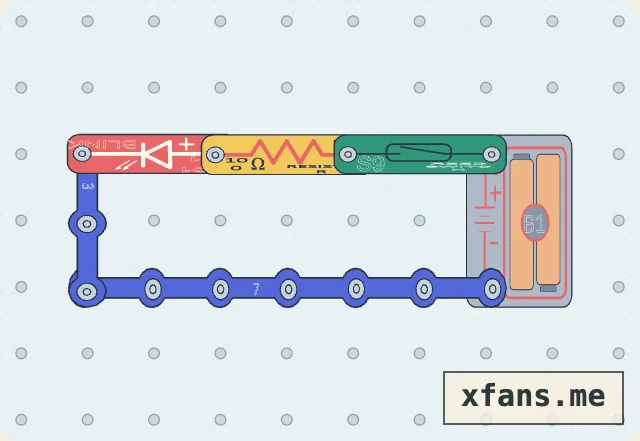
Magnetic Blinking LED
Bring a magnet near the reed switch to control a protected blinking LED.