BUILD CARD · MEDIUM
Photoresistor Night Light
Use a light-dependent voltage divider and an NPN transistor to turn an LED on in darkness.
- Time
- 30 min
- Age
- 10+
- Pieces
- 13
- Board
- 10×7
- Build and check a 10×7 snap-grid circuit from a visual diagram.
- A light-dependent voltage divider converts darkness into the transistor switching voltage.

02 / PARTS CHECK
Parts list
- 2×8-snap wireconnector
- 4×2-snap wireconnector
- 1×6-snap wireconnector
- 1×100 kΩ resistorresistor
- 1×Photoresistorsensor
- 1×NPN transistorsemiconductor
- 1×White LEDsemiconductor
- 1×100 Ω resistorresistor
- 1×3V two-cell battery holderpower
03 / ASSEMBLY
How to build the circuit
- 1
Disconnect the battery and clear the base grid before placing any part.
- 2
Match the final diagram one grid position at a time, placing connecting wires and lower layers first.
- 3
Check the direction of every LED, diode, transistor, battery, and other terminal-sensitive part.
- 4
Press every shared snap firmly, check that no wire shorts the battery, then connect power last.
04 / FIELD NOTES
How it works
The 100 kΩ resistor and photoresistor form a voltage divider at the transistor base.
In darkness the photoresistor resistance rises, allowing the fixed resistor to pull the base voltage upward.
The NPN transistor then conducts and completes the LED load path.
Explore more sensor circuit projects →
05 / TEST
Test and expected result
- What to do
- Power the circuit in normal room light, then cover the photoresistor completely.
- What to expect
- The LED turns on in darkness when the divider raises the NPN transistor base voltage.
06 / SAFETY
Build smart
- Use only the 3V battery holder.
- Do not bypass the 100 Ω LED resistor.
- Disconnect the battery before moving the transistor or divider parts.
07 / TROUBLESHOOTING
If it does not work
- Shade the photoresistor completely and wait a moment.
- Check the NPN collector, base and emitter positions against the drawing.
- Verify LED polarity and both resistor values.
08 / FREQUENTLY ASKED QUESTIONS
Questions about this circuit
What is the main idea behind this circuit?
A light-dependent voltage divider converts darkness into the transistor switching voltage.
What should I check first if it does not work?
Shade the photoresistor completely and wait a moment.
09 / RELATED BUILDS
Try a similar circuit
Continue with another build that shares the same components, ideas, or difficulty.
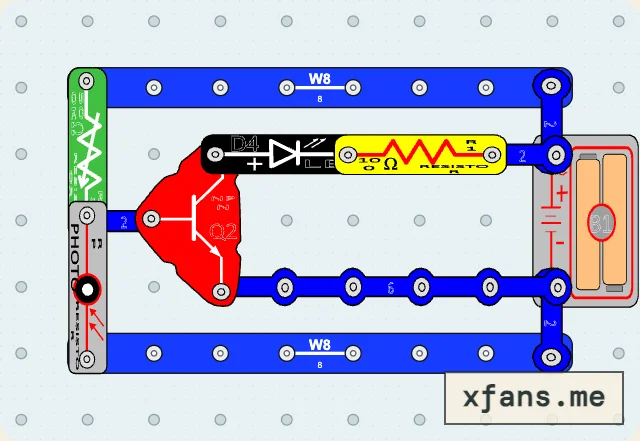
Adjustable Night-Light Threshold
Replace the fixed bias resistor with a variable resistor to choose how dark it must be before the LED turns on.
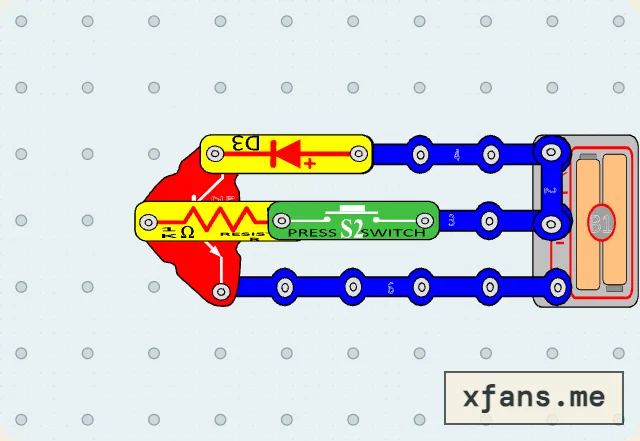
Protected Transistor Motor Driver
Add a reverse-biased diode across the motor to give inductive turn-off current a safer path.
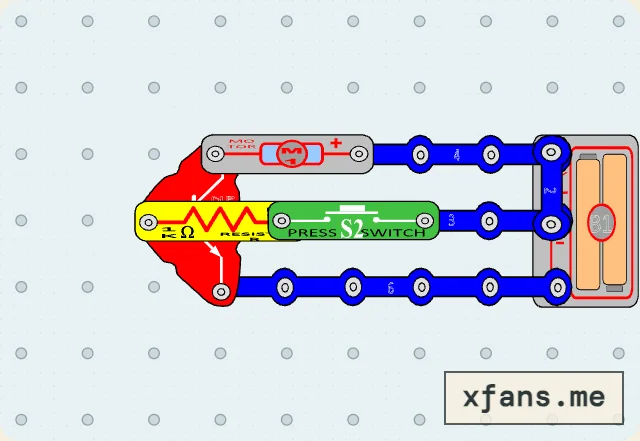
Transistor Motor Driver
Use a press switch and small base current to let an NPN transistor control a motor load.